
If your child can turn almost any conversation into a joke about poop, farts, or butts, you’re not alone. Here’s why bathroom humor is practically irresistible to kids—and why it isn’t necessarily a bad thing.
You’re sitting at the dinner table, enjoying a perfectly normal conversation, when your child announces:
“POOP!”
Suddenly, everyone under the age of ten is howling with laughter.
You sigh. You remind them that you’re eating. You attempt to change the subject.
Then somebody whispers, “Fart.”
And the entire production starts again.
What is it about poop and farts that children find so unbelievably hilarious? Why can a child hear the same bathroom joke fifty times and still laugh as though it’s the funniest thing anyone has ever said?
As it turns out, there are some interesting developmental reasons behind children’s love of potty humor.
And while you might wish your child would discover a more sophisticated form of comedy, those ridiculous jokes aren’t necessarily a bad thing.
1. Bathroom Words Have a Little Bit of Forbidden Magic
Remember how exciting it was to do something slightly naughty as a child?
Not really naughty. Just naughty enough to make an adult raise an eyebrow.
Bathroom words occupy that wonderful territory.
Children quickly learn that some words are perfectly acceptable at home but might earn them a stern look at Grandma’s dinner table.
That makes those words especially interesting.
According to the American Academy of Pediatrics, bathroom talk is common among preschoolers, particularly around the time children are learning about toilet training. These words are fascinating partly because they describe how bodies work—and partly because they can provoke such entertaining reactions from adults.
Imagine discovering that you possess a magical word capable of making your father spit out his coffee.
Wouldn’t you be tempted to use it?
For young children, a well-timed “poopy-head” can feel like a tremendous comedic achievement.
2. Kids Are Fascinated by Their Own Bodies
Adults generally don’t spend much time wondering why they fart.
We know what happens. We accept it. We move along.
Children, however, are still discovering the astonishing collection of noises, smells, and mysterious functions that come with owning a human body.
Why does your stomach growl?
Why does poop smell?
Why do people burp?
And why, exactly, does Grandpa make that noise when he stands up?
These are legitimate questions!
Bathroom humor often overlaps with genuine curiosity about biology.
A child who laughs hysterically at a fart may also be wondering where that gas came from, why it makes noise, and whether everyone does it.
The answer to that last question, incidentally, is yes.
Even Grandma.
Sorry, Grandma.
3. Surprise Is One of Comedy’s Greatest Tricks
Imagine a beautifully dressed princess sitting on a golden throne.
She lifts her teacup, smiles politely, and announces:
“EXCUSE ME. I JUST FARTED.”
For a five-year-old, this may be comedy gold.
Why?
Because something unexpected happened.
Psychologists studying humor often discuss incongruity: the difference between what we expect and what actually happens.
Children begin developing an appreciation for unexpected, silly situations early in life. As their language and understanding of social rules grow, their jokes become more elaborate.
A 2025 study published in Communications Psychology describes how children’s humor includes deliberately silly words, unexpected actions, and playful violations of social conventions—including bathroom humor.
A farting princess is funny because princesses aren’t supposed to fart.
Of course, real princesses have digestive systems just like everyone else.
Which makes the whole thing even funnier.
4. Laughter Is Contagious—Especially Between Kids
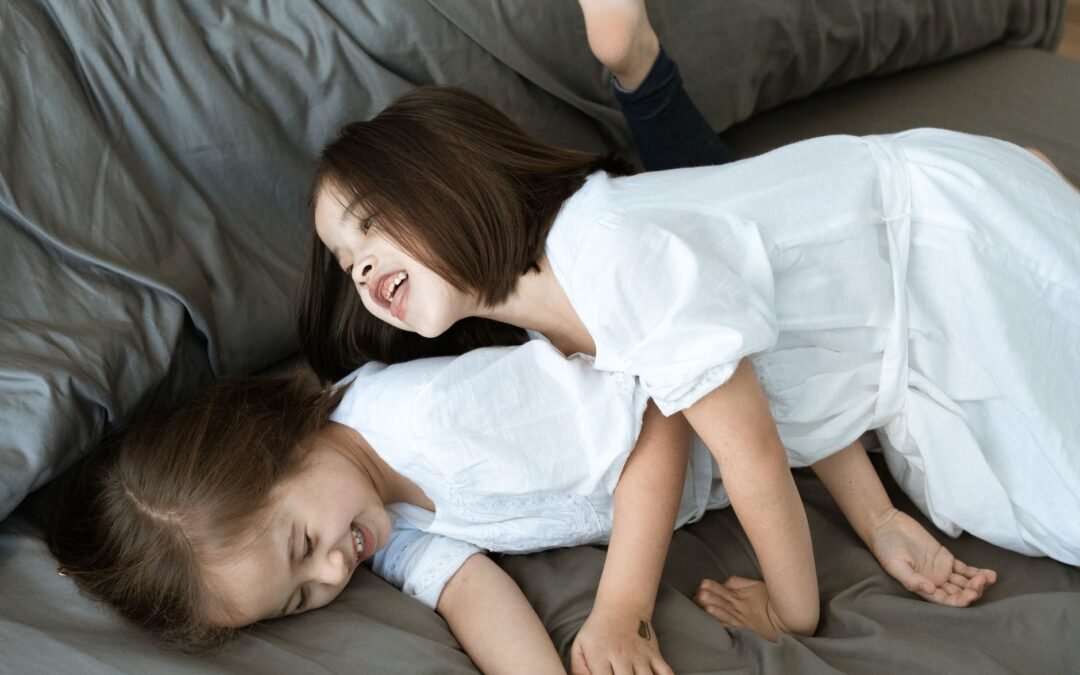
Have you ever watched two children laughing so hard that neither can explain what’s funny anymore?
One says “butt.”
The other says “butt sandwich.”
Suddenly they’re both rolling around on the floor.
The joke stopped making sense several minutes ago, but nobody seems concerned.
That’s because humor isn’t always about the joke itself. Sometimes it’s about sharing the experience.
A 2019 study in the British Journal of Developmental Psychology examined spontaneous humor between siblings during play. Researchers found that children’s joking was highly interactive, with each sibling influencing the other’s humor.
In other words, children don’t always need a brilliant punchline.
Sometimes they just need another child willing to laugh.
Bathroom jokes are particularly convenient because nearly every kid understands them.
No complicated setup required.
Just say “poop” and watch the magic happen.
5. Being Funny Gives Kids a Sense of Confidence
Children spend much of their day following instructions.
Put on your shoes.
Wash your hands.
Don’t climb that.
Please stop licking the window.
But when a child tells a joke that makes everyone laugh, something wonderful happens.
For a moment, they’re running the show.
They created the surprise. They delivered the punchline. They made people react.
And that can feel pretty exciting.
Young children experiment with humor as they develop communication and social skills. Research on early humor production has found that even two- and three-year-olds deliberately create jokes during interactions with their parents.
Bathroom humor gives children a simple way to practice being funny.
They don’t need to understand sarcasm or construct an elaborate story.
They just need a silly idea and an audience.
Preferably an audience that hasn’t already heard the joke seventeen times before breakfast.
Is Potty Humor Bad for Kids?
Not necessarily.
There’s a difference between enjoying silly bathroom jokes and using words to embarrass, insult, or hurt other people.
Laughing at a book about a farting dog? Generally harmless.
Calling another child a hurtful name? That’s something parents should address.
The American Academy of Pediatrics recommends avoiding exaggerated reactions to bathroom talk and calmly teaching children that certain language is appropriate in some situations but not others.
You don’t have to ban every poop joke from your house.
You can simply establish some reasonable boundaries.
For example:
- Bathroom jokes are fine during playtime, but not while everyone is eating.
- It’s okay to laugh about bodily functions, but not to humiliate someone.
- Questions about the human body are always welcome.
- We can be silly without being unkind.
And remember, children don’t always have perfect judgment about when a joke is appropriate.
That’s something they learn with practice.
Preferably before your next visit to a fancy restaurant.
Can Funny Books Actually Encourage Kids to Read?

Here’s where things get interesting.
Imagine two books sitting on a shelf.
One has a serious title about proper behavior.
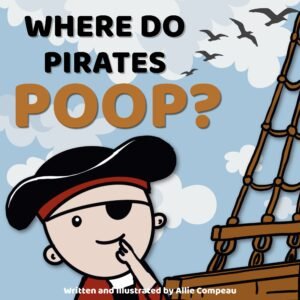
The other asks where pirates go to the bathroom.
Which one do you think a child who loves bathroom jokes might grab first?
Humor can make books appealing, particularly to children who don’t immediately think of reading as entertainment.
A silly title can spark curiosity. A ridiculous illustration can make a child want to turn the page. And an unexpected answer can keep the conversation going long after the story ends.
Funny books aren’t a replacement for every other kind of reading, of course.
But they can be a wonderful addition to a child’s bookshelf.
And sometimes the question that begins with a giggle ends with a genuine discovery.
A child who wants to know why people fart is asking a question about digestion.
A child wondering where pirates pooped is asking about history and life at sea.
Underneath the silliness, there’s an opportunity to learn something real.
What Should Parents Do When Every Joke Is About Poop?
If you’re living through the Great Bathroom Humor Era, here are a few ways to survive it.
Laugh sometimes
You don’t have to pretend every joke is hilarious. But sharing an occasional giggle shows your child that you enjoy their company.
Give them new material
Introduce knock-knock jokes, silly riddles, absurd stories, and wordplay. Bathroom humor doesn’t have to be their only comedic specialty.
Answer the real questions
When your child asks why farts smell, don’t automatically dismiss the question because it sounds gross. There’s real science behind that answer. And if you’re wondering why children seem to have an endless supply of questions, read Why Kids Ask So Many Questions — And Why We Should Let Them.
Set boundaries without making a big production
A calm “Let’s save the bathroom jokes for after dinner” is usually more useful than a dramatic reaction that turns the forbidden word into an even bigger attraction.
Read something ridiculous together
Find books that combine humor with curiosity. Let your child enjoy the silly parts, then talk about whatever interesting questions come up.
You might be surprised by how much learning begins with laughter.
The Bottom Line: Sometimes a Fart Joke Is Just a Fart Joke
Children’s humor changes as they grow.
The toddler who laughs at a funny noise may eventually become the school-age child who loves riddles, puns, and elaborate practical jokes.
But that doesn’t mean bathroom humor disappears entirely.
After all, plenty of adults still laugh when someone makes an unfortunate noise in a quiet room.
The next time your child dissolves into giggles over a poop joke, remember that the humor may reflect curiosity, an understanding of social expectations, a love of surprises, or simply the joy of making someone else laugh.
And sometimes?
A fart is just funny.
Got a Kid Who Loves Ridiculous Questions? Meet Gus!
At WhistlePig Publishing, we believe silly questions deserve entertaining answers.
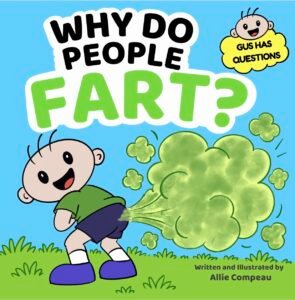
That’s why we created Gus Has Questions, a children’s picture book series that combines ridiculous possibilities with real answers.
In Where Do Pirates Poop?, Gus tackles one of history’s most pressing mysteries: Where did pirates go to the bathroom when they were sailing the seven seas?
And in Where Do People Fart?, Gus explores another question that’s guaranteed to produce a few giggles.
Both books celebrate the curiosity that makes childhood so much fun.
Because sometimes the best way to get kids interested in learning is to make them laugh first.
Explore the Gus Has Questions books and discover what Gus is wondering about next!
Sources and Further Reading
- American Academy of Pediatrics, Potty Talk: How Parents Can Discourage the Behavior
- Paine, A. L., et al. (2019). Siblings’ Shared Humour in Childhood. British Journal of Developmental Psychology.
- Humorous Peer Play and Social Understanding in Childhood. Communications Psychology, 2025.
- Hoicka, E., & Akhtar, N. (2012). Early Humour Production. British Journal of Developmental Psychology.