
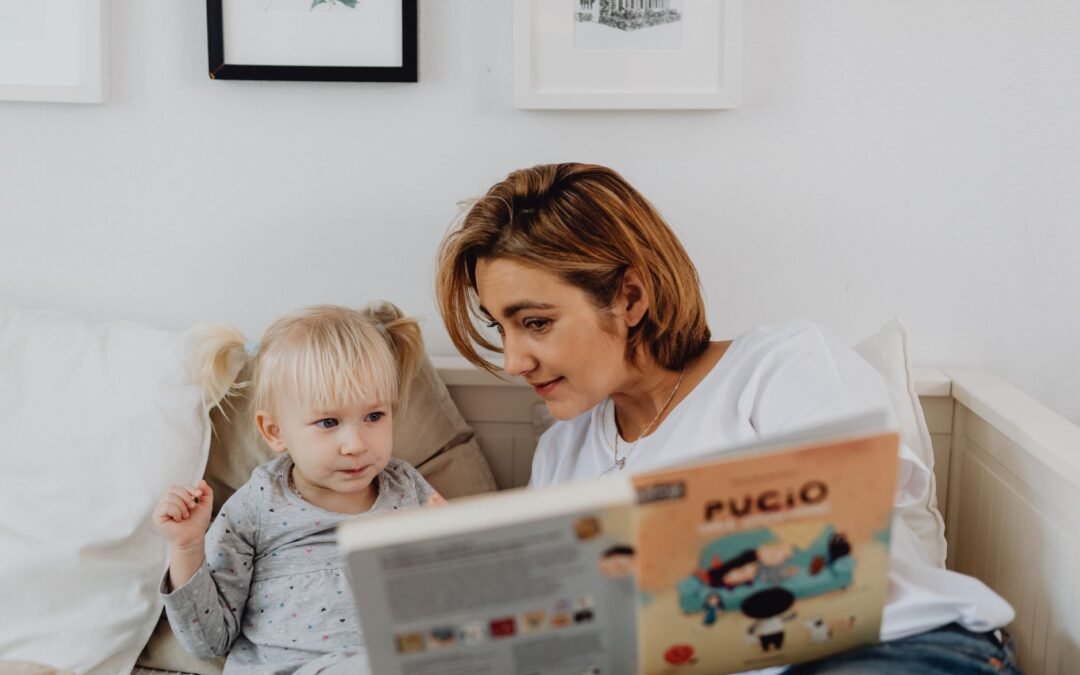
A picture-book read-aloud does not have to be a performance or a reading lesson. Some of the best moments happen when a child interrupts to point at a picture, predicts a ridiculous ending, or asks a question you weren’t expecting. You can encourage those moments without stopping on every page to test comprehension.
Here is a practical way to make reading together more conversational, especially with children who love funny stories and surprising questions.
Start with the story, not a list of questions
Before opening the book, look at the cover together. Ask one invitation, such as “What do you notice?” or “What do you think might happen?” Then begin reading. You do not need a discussion prompt for every spread. Let the story’s rhythm do its work.
With a silly picture book, the funniest moment may depend on timing. Stopping immediately before every punchline to ask a question can make the book less enjoyable. If your child is laughing, let them laugh.
Five ways to invite conversation naturally
1. Notice what the pictures add
Picture books tell stories through words and illustrations together. Sometimes the illustration shows a detail the text never mentions. Try “I didn’t notice that little thing in the corner!” and see what your child spots. This is especially useful when the character says one thing but the picture suggests another.
2. Let your child predict the next surprise
When the story reaches a genuine turning point, pause briefly: “What do you think he’ll try now?” A prediction does not need to be right. A delightfully impossible answer can be part of the fun.
3. Follow a child’s question instead of redirecting it
If a child asks why a character is doing something odd, ask what they think first. Sometimes the story will answer the question; sometimes it won’t. Either way, the exchange gives the child a chance to connect ideas and language.
4. Connect the story to familiar experiences
“Have you ever felt that surprised?” or “Does our dog do anything like that?” can help a child talk about a character. Keep these connections brief if the child wants to return to the story.
5. Revisit one favorite page
After finishing, ask which page they want to see again. Re-reading a funny illustration or repeating a favorite line is a perfectly worthwhile response. You do not need a worksheet or a written summary.
Try the PEER approach without making it formal
One research-based method for conversational shared reading is called dialogic reading. A commonly taught sequence is PEER: Prompt the child, Evaluate their response, Expand what they said, and Repeat the expanded idea. For example:
Adult: “What’s the dog doing?”
Child: “Hiding!”
Adult: “Yes, he’s hiding behind the enormous chair. Where is he hiding?”
Child: “Behind the chair!”
That sequence can help adults build conversation, but it is not a script to perform on every page. With a child who is already eager to talk, simply listening and responding may be enough. Children vary in age, language development, temperament, and interest.
When your child only wants you to read
That’s fine. Not every reading session needs questions. A tired child might want the comfort of a familiar voice and a favorite story. An enthusiastic child may want to narrate every picture. You can adjust to the moment rather than insisting on a single technique.
If your child repeatedly chooses the same book, you may wonder whether it’s time to introduce something new. Our article Why Kids Want to Read the Same Book Over and Over explores why familiar stories can remain appealing.
Make funny books even more fun to read aloud
Humor often gives children a reason to participate voluntarily. Try changing your voice for one character, pausing at a surprising picture, or letting your child supply a repeated phrase. You don’t need elaborate voices or props.
When choosing a new title, look for a clear read-aloud rhythm, expressive illustrations, and humor that fits the child. Our guide to funny picture books for ages 4–8 explains what to look for. Children who delight in asking peculiar questions may especially enjoy question-driven stories; the fun comes from sharing the surprise, not turning every question into a lesson.
A simple ten-minute read-aloud routine
- Minute 1: Let the child choose a book and look at its cover.
- Minutes 2–8: Read at a comfortable pace. Pause when your child initiates a comment or when one genuine question fits naturally.
- Minute 9: Return to a favorite picture, joke, or repeated line.
- Minute 10: Ask whether they want to read it again another day. No quiz required.
Ten minutes is an example, not a developmental requirement. Some books take longer and some children want shorter sessions. The aim is a pleasant shared experience.
What if your child asks a question you cannot answer?
“I don’t know—let’s find out” is a useful answer. You might look it up after finishing, find a related nonfiction book at the library, or simply remember the question for another day. You don’t have to abandon the story to investigate immediately.
For children who turn every page into a new question, see our guide to nonfiction books for curious kids. It can help you choose a follow-up book that satisfies a real interest rather than assigning unrelated extra work.
Common questions
Should I ask questions on every page?
No. Frequent interruptions can disrupt the story. Try a few meaningful opportunities to talk and follow your child’s cues.
Is it okay to read the same funny book every night?
Yes, if everyone is happy with it. Familiar lines and illustrations can become part of the pleasure of reading together. You can offer other books without making repetition a problem.
What if my child gives a silly answer?
Enjoy it. If the question has a factual answer that matters, you can clarify gently, but playful answers are often exactly what a humorous story invites.
Does an interactive read-aloud need a lesson plan?
No. Conversation during a story can be informal. Teachers and homeschool families may use structured prompts for specific learning goals, but ordinary family reading does not need that structure.
The goal is a child who wants another story
There is no prize for asking the most questions during a picture book. A good read-aloud leaves room for listening, laughter, curiosity, and the occasional unexpected conversation. Start with a book your child enjoys and let the interaction grow from there.
For more ideas about matching books to children’s interests, explore WhistlePig Publishing’s picture books, early readers, and chapter books guide.
Further reading
For background on dialogic reading, see the What Works Clearinghouse intervention report on dialogic reading. Research findings depend on the children and settings studied; no single reading technique guarantees a particular outcome.