
Some children want dragons. Some want dinosaurs. And some want to know where a pirate goes when he needs the bathroom.
If you’re shopping for funny picture books for ages 4–8, that last question is a useful reminder: the book that makes your child laugh might not be the one an adult would choose first. A good read-aloud meets children where their sense of humor already lives, then gives them something fun to do with it.
Here’s how to spot a book that will work beyond the first giggle—and a few silly stories worth considering.
What makes a funny picture book fun to read aloud?
1. A joke children can see coming—but not quite predict
A ridiculous question is a great opening. Could a pirate use a treasure chest as a toilet? Could a fart help someone run faster? Children enjoy inventing their own answers, especially when the next page reveals something even sillier.
Look for a story that gives listeners a moment to guess before the punchline. A good page turn can become the best part of storytime.
2. Pictures that tell part of the joke
When you’re browsing a book, open it somewhere in the middle. Can you tell that something funny is happening without reading every word? Exaggerated expressions, background details, and visual surprises give children more to discover each time they look.
For children who are not yet reading independently, the illustrations also let them participate instead of simply listening.
3. An invitation to shout, guess, or disagree
Some of the most entertaining read-alouds practically beg for a response: “No way!” “That’s not right!” “I know!”
That back-and-forth is more than a performance trick. Reading Rockets explains that conversational, or dialogic, reading encourages children to talk about pictures, make connections, and take a more active role in the story. You don’t need to turn storytime into a lesson. One well-timed “What do you think?” is plenty.
4. Humor that fits your particular child
One child thinks bodily noises are the height of comedy. Another loves absurd animals. A third laughs hardest when a character makes an embarrassing mistake and somehow survives it.
There’s no universal “funniest book.” Consider the child, the setting, and your own comfort level. A story that’s perfect for a giggly bedtime read may not be the one you’d choose for a very formal classroom visit.
5. Something left after the laughter
Not every silly book needs a moral. But it helps when the story offers a little more: a surprising fact, a kind friend, an interesting question, or a reason to keep talking after the last page.
That extra layer makes a book more than a one-joke purchase.
Three kinds of funny stories to look for
For kids who love pirates and outrageous questions
Where Do Pirates Poop? by Allie Compeau starts with a question most pirate adventures politely ignore. Young readers can guess along as Gus imagines increasingly ridiculous bathroom possibilities before the book explores the real history behind the question. It’s a playful choice for children who enjoy pirate adventures, silly guesses, and a little gross-out humor.
For kids who want the science behind something silly
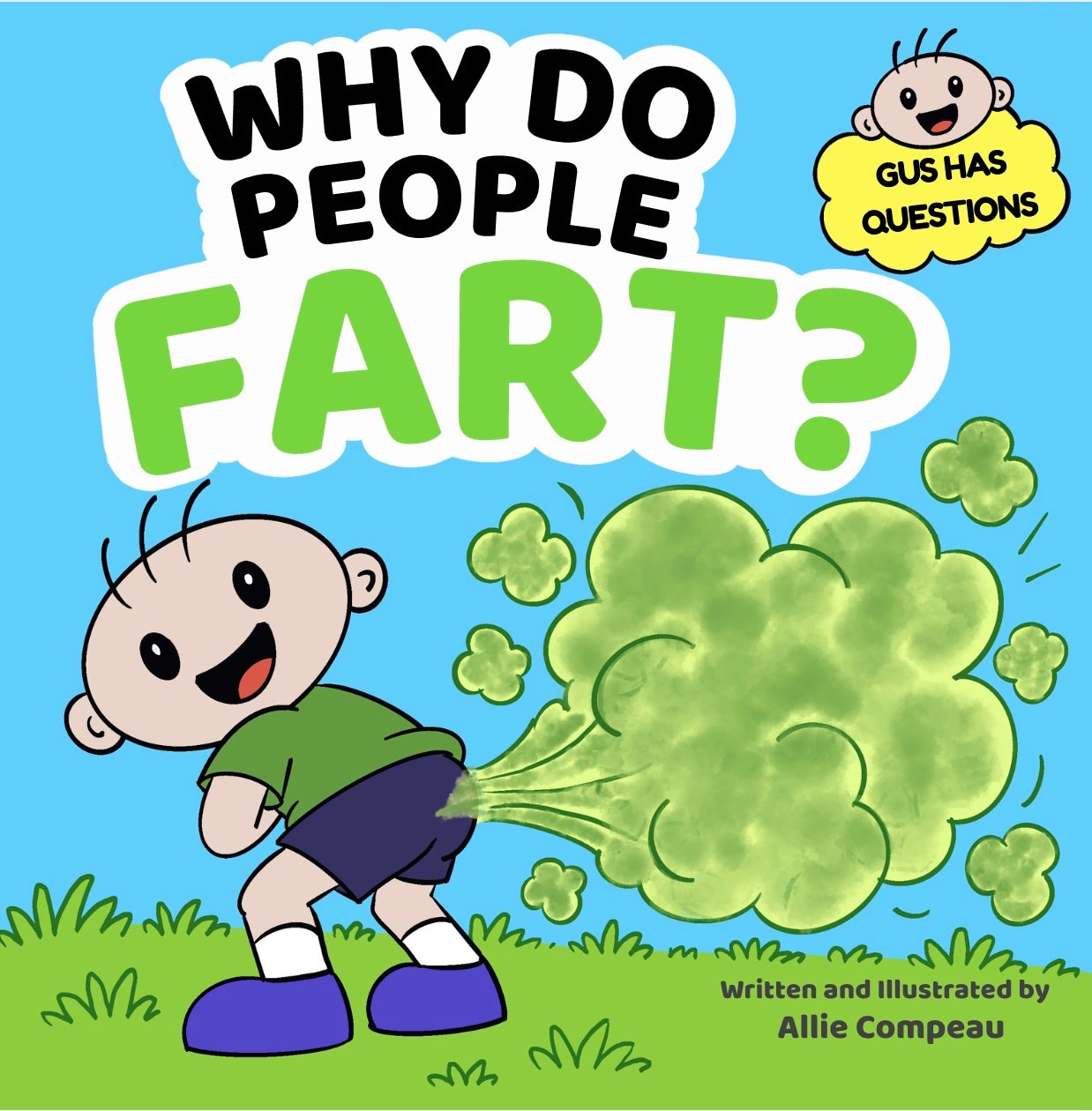
Why Do People Fart? by Allie Compeau follows Gus through wonderfully wrong theories about a perfectly normal bodily function. Is farting for speed? For scaring predators? For filling balloons? The jokes lead toward a real explanation, making it a natural pick for a child who asks “why?” about everything—even the questions adults wish they’d ask more quietly.
For kids who laugh at awkward school moments
If your child prefers character humor to outrageous questions, consider Quadrick Eats a Booger by Allie Compeau. Quadrick does something embarrassing in front of his classmates, and a friend helps him through the fallout. It offers laughs along with a gentler reminder that one awkward moment doesn’t have to define your day. Check the book’s format and reading level to see whether it suits your child.
The three-minute read-aloud test before you buy
Whether you’re at a bookstore, browsing a library shelf, or looking at an online sample, try this quick check:
- Read a page out loud. Does the wording feel natural? Can you imagine enjoying it on the fifth reading?
- Look at the pictures first. Are there details a child might point out or ask about?
- Find the participation moment. Is there a question, repeated phrase, or surprising page turn that invites a reaction?
- Think about the listener. Does the subject match what this particular child already finds funny?
Ages on book listings are useful guides, not guarantees. A child who loves being read to may enjoy a book that’s harder than they could read alone. And a child who can read independently may still love sharing a silly picture book with an adult.
Make the next read-aloud even funnier
On the first reading, let the story carry the show. On the second, pause before a ridiculous answer and invite a prediction. On the third, let your child invent a new possibility the author never considered.
You might ask, “What’s the most ridiculous answer you can think of?” or “What do you think is really happening?” If your child wants to point at the pictures and tell you a completely different story, enjoy that too.
The goal isn’t to extract a perfect answer. It’s to make books feel like something you share, not something you administer.
Ready for a read-aloud that gets the giggles going?
For children who love funny questions, the Gus Has Questions series pairs ridiculous guesses with real answers. Start with Where Do Pirates Poop? for pirate mischief or Why Do People Fart? for silly science. Both are listed for ages 4–8, and each book page has current purchase options.
And if your child laughs so hard you have to stop reading? That’s not an interruption. That’s the point.