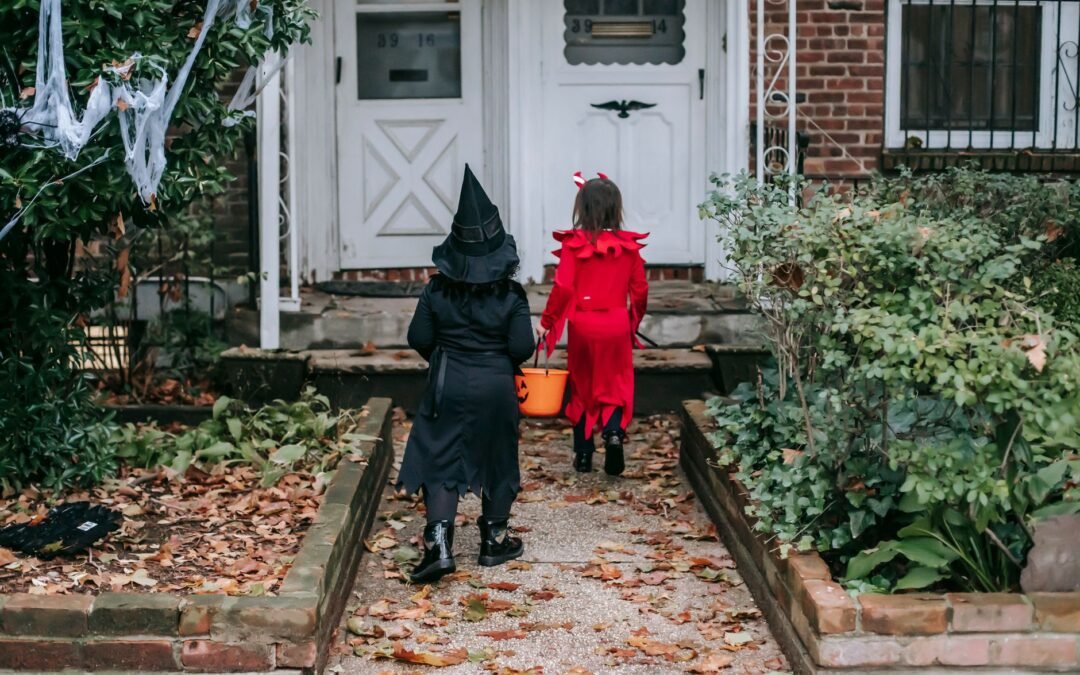
Every Halloween, millions of children put on costumes, knock on people’s doors, and demand candy.
And somehow, everyone agrees this is perfectly normal.
Think about it.
On any other night of the year, showing up at your neighbor’s house dressed like a vampire and announcing “Give me candy or there may be consequences” would be a very strange thing to do.
But on Halloween?
Grab a bucket. You’re going to need a bigger one.
So how did this happen?
Why do we trick or treat on Halloween?
The answer involves old traditions, costumes, cake, mischievous children—and eventually a LOT of candy.
Trick-or-Treating Doesn’t Have Just One Beginning
It would be nice if we could point to one person and say:
That guy. He invented trick-or-treating.
Unfortunately, history is rarely that cooperative.
Modern trick-or-treating seems to have developed from several traditions that changed and mixed together over hundreds of years. Historians have connected parts of the custom to old Celtic celebrations, Christian holidays, medieval practices, and traditions brought to North America by immigrants. HISTORY
So instead of one inventor, we have a very long game of historical telephone.
And somewhere along the way, somebody added miniature chocolate bars.
First, People Went “Souling”
Hundreds of years ago, during celebrations connected with All Souls’ Day, poor people in parts of Britain would go to wealthier homes asking for food.
In exchange, they might promise to pray for the souls of the family’s dead relatives.
One food associated with the custom was a small pastry known as a soul cake.
Eventually, children also participated, going from house to house asking for food, money, and other gifts. HISTORY
Door to door.
Ask for something tasty.
Receive something tasty.
We’re getting warmer.
Although Gus would probably like to know why we abandoned the part where people handed out cake.
Frankly, he has a point.
Then There Was Guising
Another tradition brings us even closer.
In Scotland and Ireland, children and young people participated in a custom called guising.
They dressed in disguises, went from house to house, and performed something—a song, poem, joke, or another little trick—in exchange for food, coins, or other treats. HISTORY
Now look what we’ve got:
Costume? Yep.
Going door to door? Yep.
Treats? Yep.
Children telling terrible jokes?
Some traditions truly never die.
If you’re wondering why costumes became such a big part of Halloween in the first place, we have a whole answer to Why Do We Wear Costumes on Halloween?
But Where Does the “Trick” Come From?
Here’s where things get interesting.
Halloween used to involve considerably more mischief than it does today.
By the early twentieth century, Halloween pranks in America could go well beyond ringing a doorbell and running away. Vandalism became a real problem in some communities, particularly during the 1920s and 1930s. Communities increasingly organized parties and other activities to give young people a less destructive way to celebrate. Trick-or-treating developed during this same period. HISTORY
In other words, the “trick” wasn’t necessarily an empty threat.
The basic arrangement was becoming:
Give us a treat…
…and perhaps your property will remain where you left it.
Apparently, children discovered organized crime before they discovered algebra.
When Did People Start Saying “Trick or Treat”?
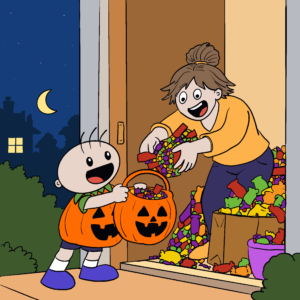
Surprisingly recently.
One of the earliest known appearances of the phrase “trick or treat” comes from a Canadian newspaper in 1927.
The report described Halloween pranksters in Blackie, Alberta, going to houses and demanding “trick or treat.”
By the 1930s, costumed trick-or-treaters were becoming increasingly familiar in parts of North America. City of Edmonton
The custom slowed during World War II, when sugar was rationed.
But after the war, sugar rationing ended, suburbs grew, and trick-or-treating took off. By the 1950s, it was becoming the Halloween tradition American kids would recognize today. HISTORY
Wait—They Didn’t Always Give Out Candy?
Nope.
This may be the most shocking fact in the entire history of Halloween.
Early trick-or-treaters might receive:
- fruit
- nuts
- coins
- toys
- homemade cookies
- pieces of cake
CAKE.
Imagine dumping out your Halloween bag and finding a loose piece of cake in there.
Candy manufacturers began promoting their products for Halloween during the 1950s. As trick-or-treating became more popular, candy was cheap, convenient, and easy to hand out.
By the 1970s, individually wrapped, factory-made candy had become the expected Halloween treat. HISTORY
And somewhere along the way, humanity apparently agreed that the person handing out raisins should be regarded with suspicion.
Did You Know?
The phrase “trick or treat” is less than 100 years old in the historical record. City of Edmonton
Children once performed songs, poems, or jokes to earn their treats. HISTORY
Halloween treats weren’t always candy. Kids could receive fruit, nuts, coins, toys, cookies, or cake. HISTORY
And trick-or-treating became especially popular in America after World War II. By the early 1950s, it was appearing in hugely popular entertainment including Peanuts and Disney’s Trick or Treat. HISTORY
So the next time someone hands you a fun-size candy bar, remember:
It could have been an apple.
Halloween Is Full of Weird Traditions
Once you start asking questions about Halloween, things get weird pretty quickly.
Why do we carve faces into pumpkins?
Why do we knock on people’s doors and expect them to give us candy?
And why do we celebrate Halloween in the first place?
Those are exactly the kinds of questions Gus likes to ask.
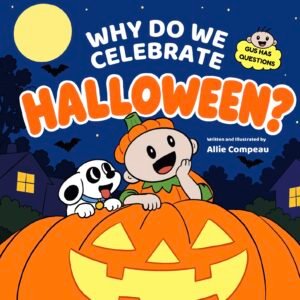
In Why Do We Celebrate Halloween?, Gus has several theories of his own before discovering the real history behind the holiday.
Are we helping dentists find more work?
Did mummies run out of toilet paper?
Do superheroes just need one night off?
Gus intends to find out.
Big Questions. Ridiculous Guesses. Real Answers.
And Jim would probably like some of that Halloween candy.
Unfortunately, chocolate is terrible for dogs.
Sorry, Jim. 🎃