
If you’ve read the same bedtime story so many times you can recite it in your sleep, there’s good news: your child’s favorite book may be doing more for their development than you realize.
“Can we read this one?”
You look down.
It’s that book.
Again.
You’ve read it every night for the past three weeks. You know every word. You know exactly where the funny part happens. You can even predict the moment your child will interrupt to point out the same tiny detail in the illustration.
You glance hopefully at the bookshelf.
“What about this one? We haven’t read it yet!”
Your child shakes their head.
“No. THIS one.”
And so begins another performance of the bedtime story you could probably deliver from memory while unloading the dishwasher.
If this sounds familiar, you’re in good company.
Young children often love hearing the same stories repeatedly. And while it can be exhausting for parents, there’s a surprisingly good reason to indulge them.
In fact, researchers have found that reading the same story multiple times can help children learn and remember new words.
So before you hide that beloved picture book behind the couch, let’s look at why your child keeps requesting it.
1. Familiar Stories Help Children Know What Comes Next
Think about your favorite movie.
You’ve probably watched it more than once, even though you already know how it ends.
You know when the exciting scene is coming. You anticipate your favorite joke. You might even say the lines along with the characters.
Children enjoy that same familiarity.
For young kids, much of the world is still unpredictable. They’re constantly encountering new experiences, learning unfamiliar words, and figuring out how things work.
But inside a favorite picture book?
They know exactly what’s going to happen.
The bear will lose his hat.
The puppy will make a mess.
The dragon will sneeze at precisely the wrong moment.
And when the moment finally arrives, it’s just as satisfying as they expected.
A familiar story can also be comforting, especially as part of a bedtime routine. While research on repeated reading primarily demonstrates learning benefits, the predictable experience itself may be part of what makes a favorite book so appealing.
2. Repetition Helps Children Learn New Words
Here’s where things get particularly interesting.
In a 2011 study published in Frontiers in Psychology, researchers investigated how three-year-old children learned unfamiliar words from picture books.
Some children heard the same stories repeatedly. Others heard different stories containing the same new words.
Both groups encountered the new words the same number of times.
But the children who heard the same stories repeatedly were better at remembering the words later.
The researchers concluded that hearing new vocabulary within a familiar story helped children retain what they had learned.
That’s pretty remarkable.
It suggests that your child’s insistence on hearing the same book isn’t necessarily limiting their learning.
Sometimes, hearing the same words in the same story is exactly what helps those words stick.
Of course, one study doesn’t mean children should read only familiar books. Variety matters too. But it gives parents a very good reason not to worry about repeated requests.
3. Your Child Notices Something New Each Time
Have you ever watched your child study an illustration you’ve barely glanced at?
“Mom! Look! The mouse is hiding behind the chair!”
You look.
Sure enough, there’s a mouse.
You’ve read this book twenty-seven times and somehow never noticed him.
Picture books are full of details that reward another look.
During the first reading, a child may be concentrating on understanding what happens.
During the second, they might pay more attention to the pictures.
By the fifth reading, they may be noticing expressions, background characters, and little visual jokes.
The words haven’t changed.
But what your child notices can change.
Try asking:
“Did you notice anything different this time?”
You might be surprised by what they’ve discovered.
And you might finally find that mouse.
4. Repeated Reading Gives Children a Chance to Participate
There’s a wonderful moment when a young child starts finishing the sentences in a favorite book.
You begin:
“Once upon a time, there was a very hungry…”
“DRAGON!” your child shouts.
They’re delighted.
They know the answer!
As children become familiar with a story, they can take a more active role in reading it.
They might predict what happens next, repeat a character’s favorite phrase, or tell part of the story themselves.
This kind of interaction can be valuable.
A 1997 study published in the Journal of Child Language found that repeated storybook reading helped preschool children learn vocabulary. Asking children to name things during repeated readings provided additional benefits for some aspects of word learning.
You don’t need to turn bedtime into a classroom lesson.
A simple pause before a familiar word can invite your child to join the fun.
And if they proudly announce that they can read the whole book themselves?
Celebrate it!
Just remember that reciting a memorized story isn’t necessarily the same as decoding printed words. Both can be enjoyable parts of a child’s early reading experience.
5. Favorite Books Can Make Children Feel Like Successful Readers
Imagine being four years old.
You’re still learning your letters. Some words are difficult. Adults seem to understand all sorts of things that you don’t.
But there’s one book you know from beginning to end.
You know every character.
You know the jokes.
You know what happens next.
And you can tell the story almost as well as the grown-up reading it.
That’s a pretty wonderful feeling.
Repeated reading gives children opportunities to participate confidently in a familiar activity.
Rather than struggling to understand an entirely new story, they can enjoy demonstrating what they already know.
And when reading feels enjoyable and achievable, children have another reason to look forward to books.
If you’re looking for more ways to encourage that enthusiasm, explore our article on Raising Children Who Love Reading.
6. Sometimes It’s Not Just About the Book
Consider what happens when you sit down to read with your child.
You put aside your phone.
You settle into a comfortable chair.
Your child snuggles beside you.
For the next ten minutes, they have your attention.
Maybe you do silly voices.
Maybe you laugh together.
Maybe they ask seventeen questions before you’ve finished the first page.
That shared experience can be just as important to your child as the story itself.
The book may be familiar, but so is the special time you spend together.
And sometimes, when a child asks for the same book again, they may be asking to repeat that experience too.
Is It Okay If My Child Only Wants One Book?
Generally, yes.
Having a favorite book is common, especially among toddlers and preschoolers.
You don’t need to force your child to choose something new every night simply because you’re tired of the old selection.
But it’s still worthwhile to offer a variety of books over time.
Different stories introduce different words, characters, settings, and ideas.
The trick is to make new books available without turning reading into a battle.
You might try keeping the favorite in your regular rotation while introducing something new alongside it.
For example:
“Let’s read your dragon book, and then you can help me choose one more.”
Or:
“Tonight you pick one book, and I’ll pick one.”
That way, your child gets the familiar story they love while gradually discovering new favorites.
And who knows?
Maybe the dragon will finally get a night off.
7. How to Make Repeated Reading Fun for Parents, Too
We understand.
There’s only so many times you can read about a lost teddy bear before you start wondering whether the bear actually wants to be found.
Fortunately, you can change the experience without changing the book.
Try silly voices
Give the characters ridiculous voices.
Maybe the king sounds like a pirate.
Maybe the dragon has an extremely polite British accent.
Maybe the mouse sounds suspiciously like Grandpa.
Your child will probably love it.
Grandpa may have questions.
Let your child tell the story
Hand over the book and ask your child to read it to you.
If they can’t read independently yet, let them retell the story using the pictures or the words they’ve memorized.
You may discover that their version includes several unexpected plot developments.
Play a picture-finding game
Choose something small in an illustration and ask your child to find it.
Or ask what they think a background character is doing.
This works especially well with detailed, funny picture books.
Ask a different question
Instead of asking what happens next, try:
“What would YOU do if that happened?”
“Which character would you want to meet?”
“What do you think happens after the story ends?”
These questions can turn a familiar book into a new conversation.
Those unexpected conversations are part of the fun. Learn more about childhood curiosity in Why Kids Ask So Many Questions — And Why We Should Let Them.
Change the ending
After you’ve finished the story, invent an alternative ending together.
What if the pirate found a spaceship?
What if the princess adopted a dinosaur?
What if the dog became king?
There are no wrong answers.
Although you may discover that your child has some very unusual ideas about royal government.
When Do Kids Stop Wanting the Same Book?
There’s no universal age when children suddenly decide they’re finished with familiar stories.
Preferences change as children grow, develop new interests, and become more independent readers.
Some children move quickly from one favorite to another.
Others return to beloved books for years.
And plenty of adults reread favorite novels, watch the same movies, and revisit familiar stories.
So perhaps children aren’t all that different from us.
They simply have fewer reservations about requesting the exact same entertainment every single night.
The Bottom Line: Read It Again
The next time your child hands you that battered picture book with the bent corners and asks you to read it for the hundredth time, remember what’s happening.
They may be strengthening their vocabulary.
They may be discovering new details.
They may be practicing telling a story.
Or they may simply love the feeling of curling up beside you and hearing something familiar.
You don’t have to say yes every single time, of course. Parents are allowed to be tired!
But you also don’t need to worry that rereading a favorite book is somehow wasted reading time.
Sometimes the best story for tonight is the one your child already knows by heart.
Even if you know it by heart, too.
Looking for Your Child’s Next Favorite Book?
At WhistlePig Publishing, we believe children’s books should spark curiosity, encourage imagination, and occasionally cause uncontrollable giggling.
Our Gus Has Questions picture book series follows a curious boy named Gus as he investigates some of childhood’s most ridiculous questions.
In Where Do Pirates Poop?, Gus wonders how pirates managed bathroom breaks aboard their ships.

In Where Do People Fart?, he tackles another mystery of the human body.
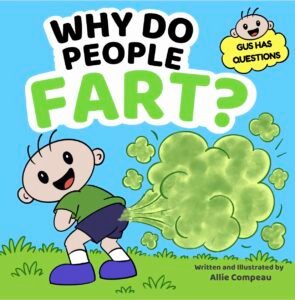
They’re silly stories with real answers, designed for curious children who love to laugh, ask questions, and discover something new.
And if your child wants to read one again tomorrow?
We certainly won’t complain.
Explore our children’s books and find your family’s next favorite story.
Sources and Further Reading
- Horst, J. S., Parsons, K. L., & Bryan, N. M. (2011). Get the Story Straight: Contextual Repetition Promotes Word Learning from Storybooks. Frontiers in Psychology.
- Sénéchal, M. (1997). The Differential Effect of Storybook Reading on Preschoolers’ Acquisition of Expressive and Receptive Vocabulary. Journal of Child Language.
- Flack, Z. M., Field, A. P., & Horst, J. S. (2018). The Effects of Shared Storybook Reading on Word Learning: A Meta-Analysis. Developmental Psychology.
Trackbacks/Pingbacks